
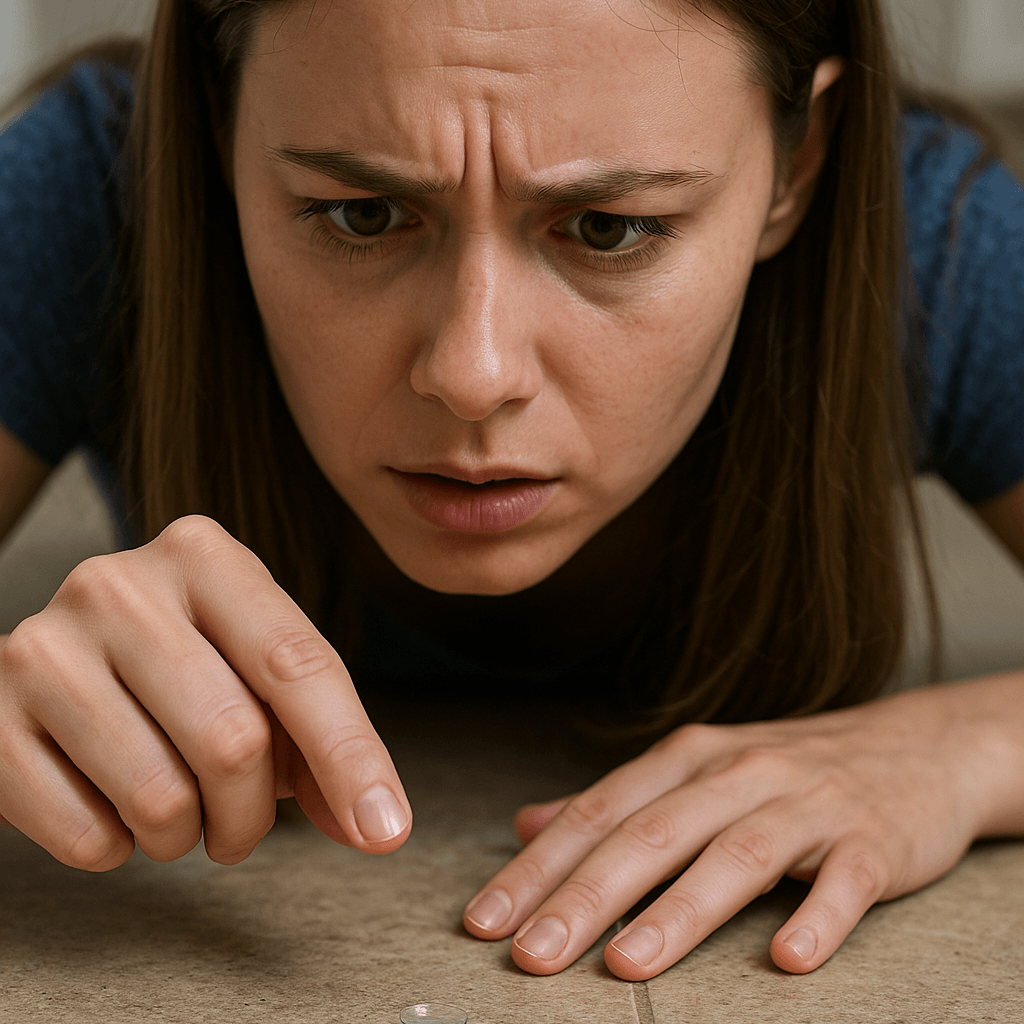
What do I do if I drop a contact lens on the floor?
Your contact lens falls on the floor. You look at it. It seems clean. And the question arises: can I clean it and put it back in?
 The quick answer is: it's best not to put it back in directly. A contact lens that has touched the floor may have come into contact with dust, fibers, bacteria, or other debris that are not always visible to the naked eye. And even if it looks intact, it may not be safe to put back in your eye.
Your eyes are sensitive, and a contaminated contact lens can cause irritation, discomfort, or increase the risk of eye infection.
First things first: don't put it in without cleaning it
If a contact lens falls on the floor, you should not pick it up and put it back in directly. Nor is it enough to blow on it, wipe it with your finger, or hold it "against the light" to check if it's clean.
A contact lens can look perfect and still have invisible particles or microorganisms clinging to it. Therefore, before thinking about reusing it, you need to consider what type of contact lens it is and what condition it is in.
If it's a daily lens, it's best to throw it away
If you drop a daily contact lens, the safest option is to discard it and open a new one.
Daily contact lenses are designed for single use. They are not cleaned or stored for later reuse. Therefore, if a daily contact lens touches the floor, it's not worth the risk: it's better to replace it with another one.
This is especially important if the contact lens has fallen in a bathroom, on the street, on a wet surface, on a carpet, or in any area where there might be dust, debris, or microorganisms.
If it's a monthly lens, can it be cleaned?
If it's a monthly contact lens, it can be cleaned and disinfected following the instructions for the care solution, but you shouldn't put it in immediately.
Cleaning removes visible deposits and debris, but disinfection is key to reducing microorganisms that can cause infections. The CDC reminds us that proper cleaning, disinfection, and storage of contact lenses are important for eye health.
For a monthly lens, the prudent thing to do would be:
- Wash and dry your hands thoroughly.
- Check that the contact lens is not torn, folded, scratched, or warped.
- Clean it with new multipurpose solution, never with water.
- Rub and rinse it with contact lens solution if the product instructions indicate.
- Store it in its case with new solution for the disinfection time recommended by the manufacturer.
If you have doubts about whether it's been properly cleaned, if it fell on a very dirty surface, or if you feel any discomfort when you put it back in, it's best not to use it.
Don't use water to clean a dropped contact lens
Never clean a contact lens with tap water, bottled water, saliva, or homemade saline solution.
Water is not suitable for cleaning or disinfecting contact lenses. The American Academy of Ophthalmology recommends not rinsing or storing contact lenses in water, and also reminds that saline solution or rewetting drops do not disinfect lenses.
This is important because water can contain microorganisms that should not come into contact with a contact lens. If you then place that contact lens in your eye, the risk of irritation or infection increases.
What if the contact lens falls in the bathroom?
If the contact lens falls in the bathroom, the recommendation should be even more cautious.
The bathroom is a humid area, with water residue, hygiene products, and surfaces where there may be more contamination. If it's a daily lens, throw it away. If it's a monthly lens, seriously consider discarding it, especially if it has fallen in the sink, shower, toilet, wet floor, or a surface that is not completely clean.
When in doubt, it's better to lose a contact lens than to risk your eye health.
What if it falls on a table or a clean surface?
Even if it falls on an apparently clean table, you still shouldn't just put it back in.
If it's a daily lens, the safest thing is still to open another one. If it's a monthly lens, you can clean and disinfect it properly with new multipurpose solution, after checking that it's not damaged.
A damaged contact lens can cause discomfort, scratches, or the sensation of a foreign body. If you notice that something is not right when you put it in, remove it immediately.
Signs you shouldn't reuse it
Do not put a dropped contact lens back in if:
- It's torn or has a small crack.
- It's folded or deformed.
- It has sticky residue that doesn't come off easily.
- It fell on a dirty or wet surface.
- It touched water.
- It causes stinging, pain, or a gritty sensation.
- Your vision is blurry when you put it in.
- Your eye becomes red or watery.
If you experience pain, significant redness, light sensitivity, discharge, or persistent blurred vision, remove the contact lens and consult a healthcare professional.
What to do if you don't have another contact lens handy
If you don't have a spare contact lens, don't improvise.
Don't clean it with water. Don't put it in your mouth. Don't use saliva. Don't store it in old solution. Don't put it in "just for a little while" if you have doubts.
The safest thing to do is wear glasses until you can open a new contact lens or until you can properly clean and disinfect a monthly contact lens with the appropriate solution.
That's why it can be helpful to always carry with you:
- A clean case.
- Multipurpose solution for monthly contact lenses.
- Spare glasses.
- An extra daily contact lens if you use daily disposable contact lenses.
How to prevent a contact lens from falling out
It can't always be avoided, but these habits help:
- Handle contact lenses over a clean surface.
- Avoid putting them in right over an open sink.
- Wash and dry your hands thoroughly before touching them.
- Place a clean towel on the surface if you're just starting out.
- Always check that the contact lens is properly placed on your fingertip.
- Don't rush when putting them in or taking them out.
A good routine greatly reduces errors and makes wearing contact lenses easier.
Conclusion
So, what do I do if a contact lens falls on the floor?
If it's a daily contact lens, the safest thing is to throw it away and open a new one. If it's a monthly contact lens, don't put it in directly: clean and disinfect it with an appropriate solution, following the product instructions, and discard it if you have any doubts.
Never use water, saliva, or old solution to clean a dropped contact lens. Your eyes are too sensitive to risk for a contact lens.
At OpticVue, you can find daily and monthly contact lenses for myopia, as well as contact lens solution to complete your monthly care routine.
FAQ
Can I put a contact lens back in if it falls on the floor?
You shouldn't put it back in directly. If it's a daily lens, it's safest to discard it. If it's a monthly lens, clean and disinfect it properly before reusing it.
Can I clean a dropped contact lens with water?
No. It is not recommended to clean or store contact lenses in water. Always use specific contact lens solution.
What happens if I put in a dirty contact lens?
It can cause irritation, redness, discomfort, or increase the risk of eye infection. If you experience pain, blurred vision, or light sensitivity, remove it and consult a professional.
Can a daily contact lens be cleaned if it falls?
Daily contact lenses are designed for single use. If they fall on the floor, it's safest to throw them away and use a new one.
Can a monthly contact lens be reused if it falls?
Only if it is not damaged and is properly cleaned and disinfected with appropriate solution. If it has touched water, fallen on a dirty surface, or causes you any doubts, it's better to discard it.
Can I use saline solution to disinfect a contact lens?
No. Saline solution may be used for rinsing in some cases, but it does not disinfect. To disinfect a contact lens, you need a solution specifically designed for that purpose.


Leave a comment
This site is protected by hCaptcha and the hCaptcha Privacy Policy and Terms of Service apply.