
How many hours a day should I wear contact lenses
Wearing contact lenses until night doesn't always mean your eyes are handling it well. If you're wondering how many hours to wear daily contact lenses, the short answer is: it depends on the type of lens, how well your eyes tolerate continuous wear, and whether you notice signs of fatigue, dryness, or irritation.
There isn't a universal number that applies to everyone. As a general guideline, many people wear their contact lenses for 8 to 12 hours a day without problems, but that doesn't make this range a fixed rule. In visual health, being comfortable is not the same as pushing the limits. And that difference is noticeable.
How many hours to safely wear daily contact lenses
The safe wearing time changes depending on several factors. The first is the type of contact lens you wear. A daily lens is designed to be worn during the day and discarded afterward. A monthly lens can offer good performance for more days of the month, but that doesn't mean you should wear it for more hours each day.
The quality of the material also plays a big role. Contact lenses with good hydration and high oxygen transmissibility are usually tolerated better for longer, especially if you spend hours in front of screens, in air-conditioned offices, or in dry environments. Even so, even a lens designed for prolonged comfort has limits. If the eye becomes dry or irritated, it's best to remove it sooner.
The most prudent reference is always to follow the guidelines indicated by your eye care professional and the manufacturer. If no one has given you specific guidelines, wearing contact lenses only for the necessary hours and removing them as soon as discomfort appears is usually the most sensible option.
It's not just about the hours: it's about how your eyes feel at the end of the day
Two people can wear contact lenses for the same number of hours with very different results. One might be perfectly fine after 10 hours, and another might start to feel stinging after 6. This is not uncommon. Tolerance depends on tear quality, lens material, fit, prescription, and even daily routine.
That's why it's worth paying attention to how your eyes feel at the end of the day. If you feel immediate relief when you remove them, frequent redness, or blurrier vision at the end of the day, you're probably overextending your daily wear or need a more suitable type of contact lens.
For users with dry eyes, for example, the problem isn't always the total number of hours, but the drop in comfort after a certain point. In these cases, a daily lens with better hydration or a range designed for dry eyes often works better than insisting on wearing an unsuitable lens until night.
Factors that change the recommended time
The question of how many hours to wear daily contact lenses isn't answered by just looking at the clock. There are conditions that significantly shorten or extend real tolerance.
Type of contact lens
Daily contact lenses are often the most comfortable option for many people because you start each day with a fresh pair. This reduces deposit buildup and greatly simplifies maintenance. Monthly lenses can work very well, but they require rigorous hygiene and good care to maintain comfort throughout the day.
Tear quality and dry eyes
If you usually notice dryness, itching, or a gritty sensation, it's common for the comfortable wearing time to be shorter. It's not advisable to force it here. A dry eye usually appreciates more hydrated materials or those with better oxygen permeability.
Environment and routine
Spending the day outdoors is not the same as spending eight hours in front of a screen in an air-conditioned office. We blink less in front of the computer, which worsens dryness. Smoke, dust, and air conditioning also affect it.
First weeks of adaptation
If you've just started wearing contact lenses, it's common to gradually increase the wearing hours. Starting with long hours from the first day usually causes more discomfort and makes adaptation worse than necessary.
Signs you should remove them sooner
Sometimes the mistake isn't wearing contact lenses for too many hours, but ignoring what your eye is telling you. There are several clear signs that it's advisable to remove them and rest.
If you notice stinging, red eyes, unstable vision, a foreign body sensation, or dryness that doesn't improve with blinking, it's not worth continuing. Removing your contact lenses in time can prevent a temporary discomfort from turning into a more serious irritation.
You also shouldn't normalize daily discomfort. Wearing contact lenses shouldn't be a test of endurance. If almost every day you end up desperately wanting to remove them, it's time to review your wearing schedule or the type of contact lens.
Sleeping with contact lenses: the most problematic mistake
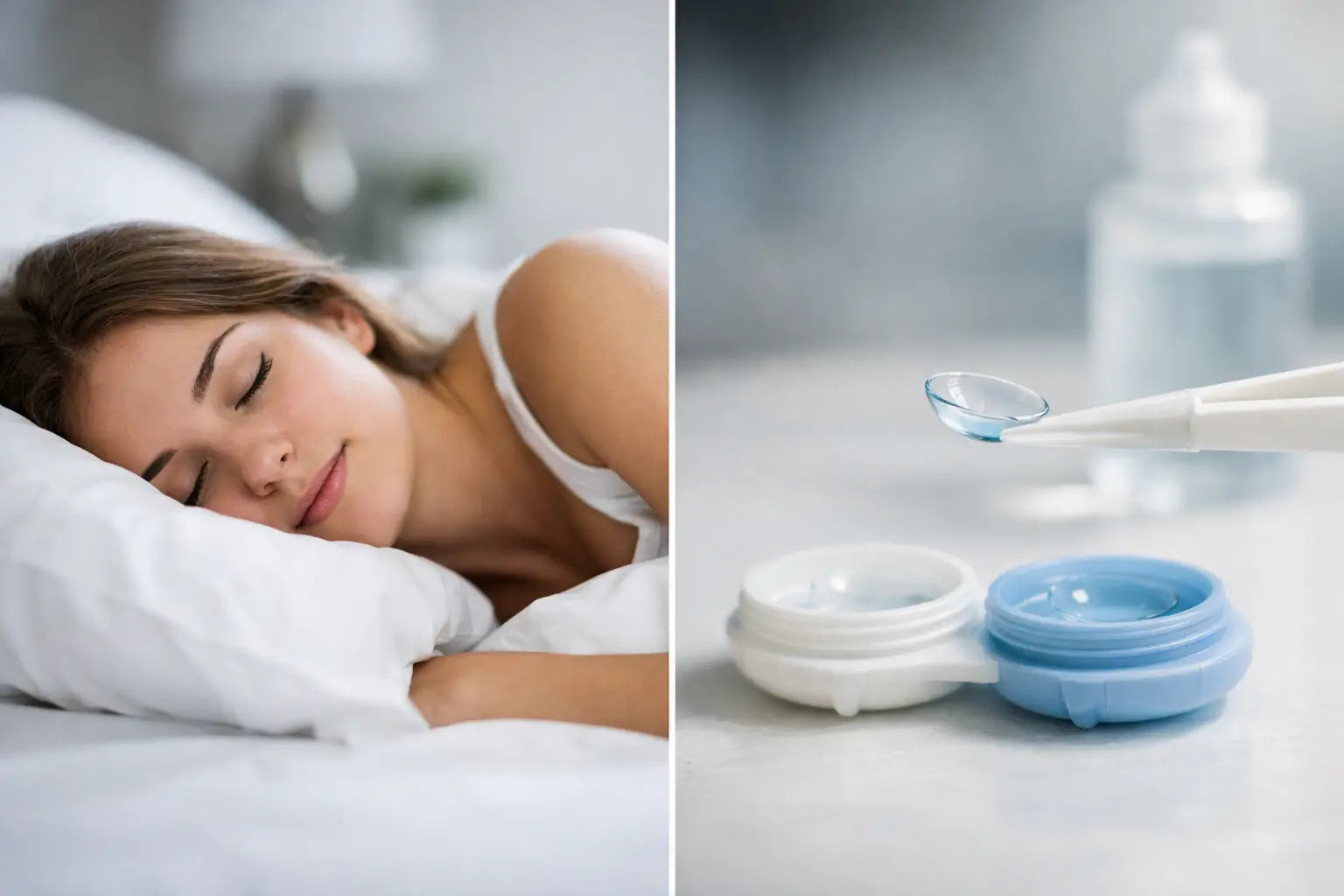
Even if it seems like a short nap, sleeping with contact lenses increases the risk of complications. The eye receives less oxygen when the eyelid is closed, and the contact lens adds another barrier. The result can range from intense dryness upon waking to irritation or major problems.
Even with advanced contact lens materials, sleeping with them should only be done if they are specifically indicated for that use and under professional recommendation. In practice, if your contact lenses are for regular daily use, the simple rule is to always remove them before sleeping.
How to extend comfort without forcing hours
If you're just making it to the end of the day, you don't always need to stop wearing contact lenses. Sometimes, adjusting a few habits is enough. Taking visual breaks, blinking more when using screens, and avoiding overly dry environments helps a lot.
Choosing wisely between daily and monthly lenses also matters a lot. If you're looking for maximum convenience and zero maintenance, dailies usually win. If you prioritize savings for frequent use, monthlies can compensate, but only if you take good care of them and don't sacrifice comfort. The best price isn't worth much if you end up removing them prematurely every afternoon.
When dryness is part of the problem, it's worth considering lenses designed to maintain hydration for more hours. For a brand like OpticVue, for example, it makes sense to look at ranges aimed at dry eyes or prolonged wear, as long as they fit your visual recommendation.
How many hours to wear daily contact lenses if you work with screens
This is a very common situation. Many people tolerate contact lenses well in the morning and start to feel them heavy in the mid-afternoon. It's not always the contact lens's fault. Often, it's the combination of screen time, poor ventilation, and less blinking.
If you work with a computer, it's reasonable not to push the hours out of habit. If you know that after a certain point you start to feel worse, remove them earlier when you get home or alternate with glasses during less necessary parts of the day. This combination gives your eyes a rest and usually greatly improves the overall experience.
Is there an absolute maximum?
There isn't a single number that works for everyone, but there is a useful idea: if your contact lenses only work well for you up to a certain point, that point is your practical limit, even if in theory you could wear them longer. Responsible use isn't about seeing how much you can endure, but about maintaining constant comfort and eye health.
For many people, a range of 8 to 12 hours can be reasonable. For others, 6 or 8 hours is already enough. And for users with good tolerance and appropriate materials, the time can be longer. The key isn't to compete with an average, but to respect your eyes' response.
The most sensible daily guideline
If you're looking for a practical reference, this works well: put on your contact lenses with clean hands, wear them only for the hours you truly need them, do not sleep with them, and remove them as soon as you notice non-temporary discomfort. If at the end of the day you can still see well and your eyes are comfortable, you're on the right track. If not, it's time to adjust.
And if you've been wondering how many hours to wear daily contact lenses because you end up feeling the same every afternoon, don't just dismiss it as normal. Sometimes the difference isn't about enduring more, but about wearing the right contact lenses for your lifestyle and for how your eyes are.

Leave a comment
This site is protected by hCaptcha and the hCaptcha Privacy Policy and Terms of Service apply.